
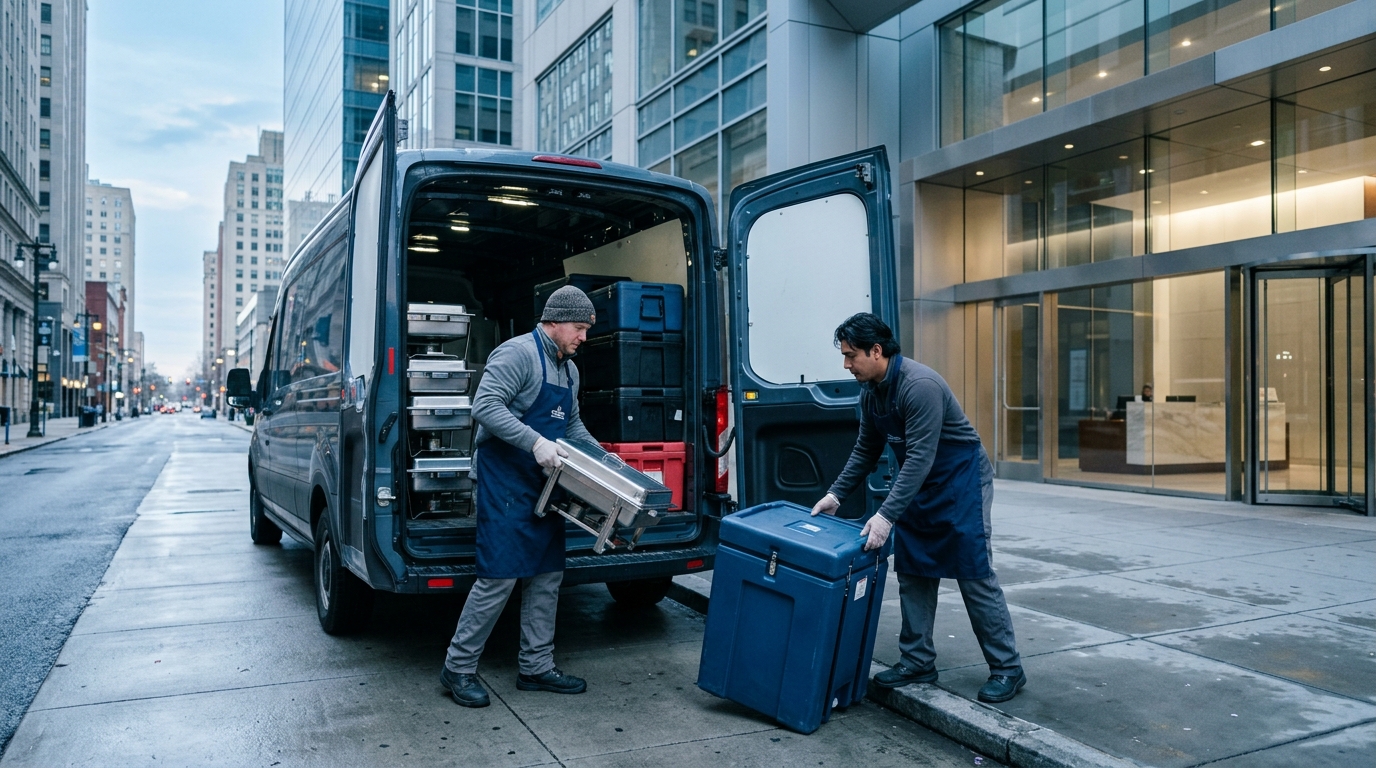
A Day in the Life: How Waterfront Gourmet Preps a Large Corporate Catering Order
By Waterfront Gourmet · 10/5/2026
When a corporate catering order for 80–150 people lands in Waterfront Gourmet's inbox, a precise, multi-stage production sequence kicks off well before the first tray ever leaves the kitchen. Here is exactly how that process works, from the first phone call to the final delivery in Center City Philadelphia.
The Order Intake: More Than Just a Headcount
Every large corporate catering order starts with a structured intake call, not a quick email exchange. Waterfront Gourmet's team collects six pieces of information before any pricing is confirmed:
- Headcount and buffer: Clients give a number, but the kitchen plans for 10–15% above it. A meeting that was supposed to have 80 attendees often ends up with 90 when last-minute colleagues join.
- Dietary breakdown: Gluten-free, vegetarian, vegan, and allergen flags (especially nut and shellfish) are logged individually, not lumped into a single "dietary requests" note.
- Delivery address and floor access: Center City Philadelphia buildings vary wildly. Some have loading docks; some require a service elevator reservation 48 hours in advance. Getting this wrong costs real time on delivery day.
- Service style: Drop-off only versus staffed setup changes the labor estimate significantly. A drop-off for 100 people takes roughly 20 minutes on-site; a staffed setup with chafing dishes and attendants can take 45–60 minutes.
- Time window: Corporate breakfast catering in Philadelphia typically needs to be set up before 8:30 a.m., which means the kitchen starts production by 5:00 a.m. That constraint shapes the entire prep schedule.
- Budget range: This is collected upfront, not at the proposal stage. It allows the team to recommend a menu tier that actually fits rather than sending a proposal the client has to cut in half.
Once those six items are confirmed, the order moves into the production planning phase within two business hours. For orders over 75 people, a dedicated order sheet is created and assigned to a lead kitchen coordinator.
Menu Building: Balancing Variety Against Execution Risk
The biggest operational mistake in large-scale Philadelphia business catering is over-complicating the menu. Every additional item adds a preparation step, a holding container, a labeled allergen card, and a slot in the van. Waterfront Gourmet structures large corporate menus around a core-plus-complement model:
- Core items (60–70% of spread): High-volume, crowd-safe options that travel well and hold temperature reliably. For breakfast catering, this means items like egg casseroles, assorted bagels with spreads, and seasonal fruit trays. For deli catering services, it means a rotation of sliced meats, artisan breads, and composed salads.
- Complement items (30–40% of spread): Differentiators that give the order personality without multiplying prep complexity. These might include a specialty pastry from the bakery team, a house-made dip, or a rotating seasonal grain salad.
The kitchen uses a hard rule: no item on a large order is introduced for the first time on the day of service. Every component has already been prepared and quality-checked at scale at least once before. This eliminates the "it looked fine in small batches" problem that causes real catering failures.
The Night-Before Prep Window: Where the Order Actually Gets Built
For a morning delivery, the majority of production happens between 3:00 p.m. and 9:00 p.m. the evening before. This is when the kitchen operates at its most structured:
- Cold components, composed salads, and sliced deli proteins are fully assembled and portioned into labeled hotel pans.
- Bread, pastries, and anything with a critical texture window are prepped but not fully assembled. Croissants, for example, are baked fresh in the morning to preserve flake and crumb structure.
- All allergen-specific items are prepared first, before any cross-contact risk exists in the kitchen, then stored in sealed, labeled containers on a designated shelf.
- Packaging is staged: delivery bags, serving utensils, tongs, napkins, serving labels, and any rental equipment like chafing racks are grouped by order and positioned near the loading area.
A physical checklist, specific to that order's menu and headcount, is printed and signed off by the lead coordinator. Digital systems are useful for intake, but in a production kitchen operating before dawn, a laminated sheet that gets checked by hand is less vulnerable to human error than a screen.
Morning Execution: The Final Two Hours
The final production window is the most time-compressed part of the process. For an 8:30 a.m. setup in Center City, the team is operating on a timeline that looks like this:
- 5:00 a.m.: Kitchen opens. Hot items enter the oven. Freshly baked goods go into warming. Coffee service equipment is prepped and tested.
- 6:00 a.m.: Hot trays are pulled, held at temperature in transport equipment calibrated to maintain 140°F minimum. Cold trays are pulled from refrigeration and staged for loading.
- 6:30 a.m.: Van is loaded in reverse delivery order: the last tray placed in is the first one off at the delivery site. Allergen-specific containers are loaded separately and labeled with the client contact's name.
- 7:00 a.m.: Departure, accounting for Center City traffic patterns. The team adds 15 minutes to any estimated drive time during the 7:00–9:00 a.m. window.
- 7:45–8:00 a.m.: Arrival and setup. Drop-off orders are organized and labeled on-site in under 20 minutes. Staffed setups include chafing dish assembly, Sterno lighting, and a final presentation check.
The two-person delivery team always carries a backup kit: extra serving utensils, a roll of labels, a portable heating unit, and direct phone access to the kitchen coordinator. If a tray is short or a last-minute dietary accommodation appears on-site, there is a resolution path that does not involve the client watching someone scramble.
What Makes Philadelphia Corporate Catering Specifically Harder
Catering for businesses in Center City Philadelphia presents logistics that do not show up in suburban or campus catering. Three constraints are worth understanding:
- Parking and load-in time: There are no guaranteed loading zones in much of Center City. The team either pre-coordinates with building security for a reserved spot or factors in 10–15 minutes of circling and hand-trucking from a metered space. This is built into the timeline, not treated as a surprise.
- Elevator capacity and scheduling: Large office towers often have freight elevator blackout windows between 8:00 and 9:00 a.m. Waterfront Gourmet contacts building management for every new venue and keeps a running log of elevator constraints at repeat client buildings.
- Setup space at the destination: Some conference rooms have a six-foot table for setup; some have a credenza. The team asks for a photo of the intended setup area during intake for any order over 50 people. Knowing whether there are outlets for warming equipment prevents an awkward conversation 20 minutes before guests arrive.
Quality Checks and Client Communication After Delivery
Once setup is complete, Waterfront Gourmet sends a brief confirmation text to the client contact that includes a photo of the completed spread and a direct number to call if anything needs immediate attention. This takes 90 seconds and prevents the most common post-delivery complaint: the client did not know the food had arrived and guests were left to find it themselves.
For recurring corporate clients, the team keeps a running order history: what was popular, what was left untouched, any dietary flags that came up at service, and any building access notes for the next visit. A second order from the same client should run smoother than the first, not identical to it.
Philadelphia Corporate Catering FAQ
How far in advance should a business book a large corporate catering order in Philadelphia?
For orders serving 75 or more people, book at least 5 business days in advance. Orders requiring custom menu items, staffed setup, or weekend delivery benefit from 7–10 business days of lead time. Last-minute orders under 48 hours are possible for some menu configurations but carry a rush fee and a more limited menu selection.
Does Waterfront Gourmet handle breakfast catering for early morning meetings in Center City?
Yes. Breakfast catering setups before 8:30 a.m. are a standard service. The kitchen starts production as early as 5:00 a.m. for morning orders. Clients should flag early start times during intake so the production schedule is set correctly from the beginning.
What is the difference between drop-off catering and staffed setup for a corporate event?
Drop-off catering means the team delivers, organizes, and labels everything on-site in 15–20 minutes, then leaves. Staffed setup includes full presentation assembly, chafing dish service, and a team member who stays for the duration or for a set service window. Staffed setup is recommended for events where guests are served in real time rather than grazing from a buffet.
How does Waterfront Gourmet handle dietary restrictions for large groups?
Dietary needs are collected at intake and tracked on the order sheet. Allergen-specific items are prepared first in the kitchen before cross-contact risk exists, sealed, labeled with the individual flag (e.g., "gluten-free" or "vegan"), and loaded separately. They are never mixed into the general spread without a distinct label visible to guests.
Can a business set up a recurring corporate catering account with Waterfront Gourmet?
Yes. Recurring accounts are managed with an order history file that tracks menu performance, headcount trends, building access notes, and any standing dietary requirements. Regular clients can establish a standing order template that reduces intake time on repeat orders to under 10 minutes.